
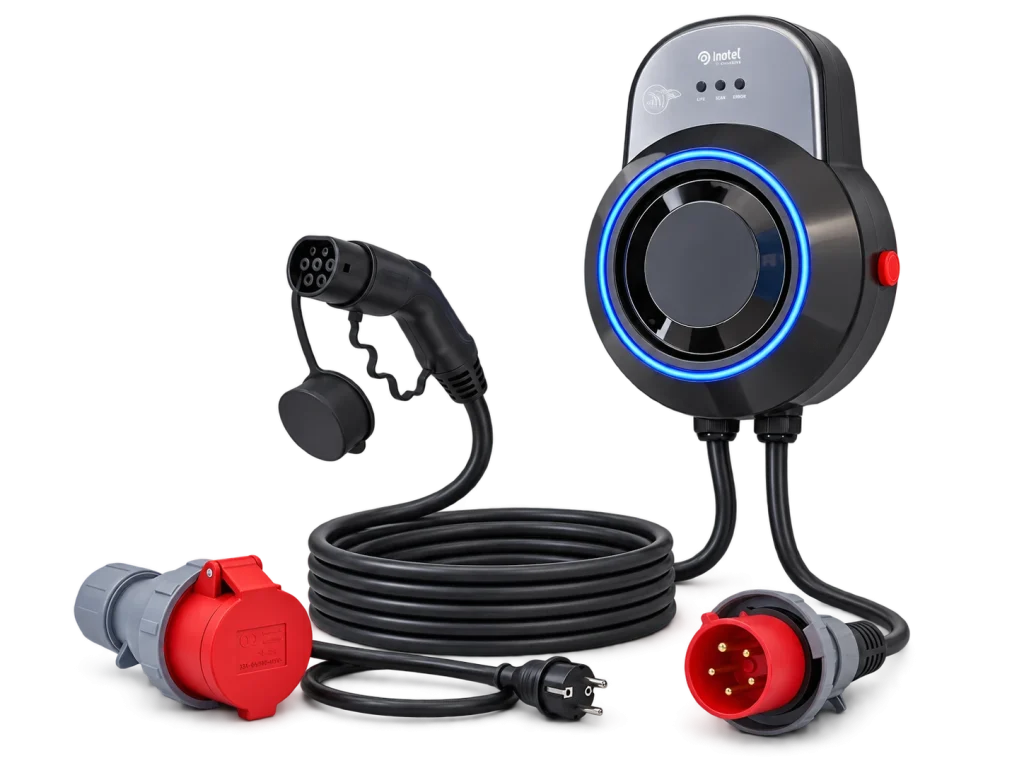
Choose a tethered wallbox if having the vehicle cable ready on the wall makes your daily routine easier. Consider a socketed unit if you prefer to disconnect and store a suitable cable after charging. Neither arrangement is inherently faster. The practical question is which connection works comfortably in your parking space while meeting the requirements of your vehicle and electrical installation.
Start with an ordinary evening at home
Imagine arriving in the rain with shopping in the boot. A tethered cable is already attached to the charger, so you only connect the vehicle end. A socketed unit asks you to retrieve your cable and connect both ends. That additional step may be perfectly acceptable if keeping the wall clear between sessions matters more to you.
Now imagine the car parked facing the other way. Will the cable still reach the inlet without tension or crossing a walking route? This small test is often more useful than comparing product photographs. Include garage doors, another parked car and the place where the connector will rest when unused.
What each format includes
| Everyday consideration | Tethered charger | Socketed charger |
|---|---|---|
| Vehicle connection | Attached charging cable | Separate compatible cable |
| Between sessions | Cable stays with the unit | Cable can be removed |
| Reach | Check the supplied length | Select an appropriate cable |
A socketed charger is not wireless charging. A cable must still connect the car to the unit. A socket also does not establish whether a separate cable is included in the purchase. Confirm the delivery contents rather than assuming that a product photograph lists everything supplied.
Cable length is a usability decision
Measure the actual route around the car, allowing normal movement without stretching the cable. Extra length needs somewhere safe to go; a long cable left across a path is not an improvement. Do not plan to bridge a short charging cable with a domestic extension lead. If your parking arrangement cannot accommodate a safe route, reconsider the charger position with the installer.
Connection format and charging speed are different questions
The car’s onboard AC charger, the wallbox setting, the cable rating and the available supply all constrain the session. As a hypothetical example, a vehicle accepting up to 11 kW AC cannot take 22 kW AC simply because the wallbox carries a 22 kW rating. Choosing the socketed or tethered version does not remove that limit.
For a detachable cable, the connector shape is only the first check. Its current and phase ratings also need to suit the vehicle and equipment. Ask for the specification of the actual cable you intend to use. Do not treat an unverified adaptor as a shortcut to compatibility, and leave repairs to attached cables to the appropriate service professional.
Sharing a parking space
Two cars may have different inlet positions and AC charging limits even when both use Type 2. Evaluate both cars individually. A removable cable can offer flexibility in storage and cable selection, but a socketed wallbox is not automatically universal and does not automatically charge two vehicles at once.
Access control is another independent choice. Consider who may start a session and how they will identify themselves. Network connectivity, app access and RFID should be checked against the specific product rather than inferred from whether the cable is attached.
Applying the comparison to INOCHARGE
The current INOCHARGE cabled AC charger has a 5 m attached vehicle cable with a Type 2 plug. The socketed AC charger has a Type 2 outlet and no attached vehicle cable. Both current families offer 7/11/22 kW power settings for a three-phase supply, subject to vehicle and installation limits.
Use these details to test your own scenario: is 5 m sufficient for the way you park, and do you already own a suitable cable for a socketed unit? Then confirm the proposed power setting with a qualified installer. Use the INOCHARGE model comparison to review the connection formats, then confirm the installation arrangement through a site assessment.
For background, see AFDC’s explanation of charging equipment and Electrical Safety First’s EV guidance. Country-specific installation rules in those references should not be transferred to another jurisdiction without professional review.
For your parking routine, compare the worked AC charging-time example and review the home installation planning checklist before deciding where to place the unit.
Source links and technical information last checked: 17 November 2026.