
Start a wallbox compatibility check with the vehicle’s AC charging specification. The prominent DC rapid-charging figure in a brochure does not tell you what the car can accept from a home AC unit. Connector type, onboard charger (OBC) capacity, cable capability and the electrical installation all need to work together.
Find the specification for your exact car
A model name alone may be insufficient. Model year, battery option, equipment and market can change charging specifications. Use the relevant handbook or manufacturer documentation, and ask the manufacturer for clarification if the exact configuration is unclear. You do not need to post private vehicle documents publicly to obtain that clarification.
Collect four items:
- The vehicle’s AC inlet type.
- Its maximum onboard AC charging power and supported phase arrangement.
- The manufacturer’s requirements for the charging cable.
- Recommended charging targets and relevant operating conditions.
Avoid borrowing a rating from a forum post about a similar car. Even a correct figure for one version may be wrong for another. If the source only says “fast charging”, establish whether it is describing AC or DC before using the number in a wallbox comparison.
Separate power, energy and the charging path
AC charging uses the car’s onboard charger to convert incoming AC into DC for the battery. With DC charging, that conversion takes place outside the vehicle. These paths have different limits. A high DC peak specification therefore cannot be carried over to a home AC charging estimate.
Battery capacity in kWh is a separate quantity again. It describes energy, while kW describes power. A larger battery may require more energy for the same change in charge percentage, but its size does not establish how much AC power it accepts. The onboard charger and charging controls matter.
Work through the limits together
| Hypothetical combination | What constrains the session? |
|---|---|
| 11 kW AC vehicle, 22 kW wallbox, other conditions suitable | The vehicle limits AC power to 11 kW |
| 22 kW AC vehicle, installation limited to 11 kW | The installation limits power to 11 kW |
| Connector fits, cable rating unknown | Full compatibility remains unverified |
These are examples, not specifications for named vehicles. Actual power may be lower because of settings, temperature or other operating conditions. A higher-rated wallbox can be suitable for a lower-rated car when the connection and installation requirements are met; it does not upgrade the car’s onboard charger.
Phase support needs its own check
The car’s supported phases, the building’s supply and the wallbox’s approved connection are separate facts. For example, a hypothetical OBC accepting only one phase at 16 A is limited to about 3.7 kW at 230 V; a 22 kW label does not raise that limit. This is not a specification for a named car or a statement of INOCHARGE single-phase compatibility. Do not assume that a 7 kW setting proves a particular three-phase unit can be installed on any single-phase supply. Compare the exact product documentation with the vehicle requirements and the installer’s assessment.
This distinction also explains why comparing only two headline kW figures can mislead. Ask the installer to confirm the proposed operating arrangement, rather than treating a maximum power label as a complete wiring specification.
Include the cable and the parking position
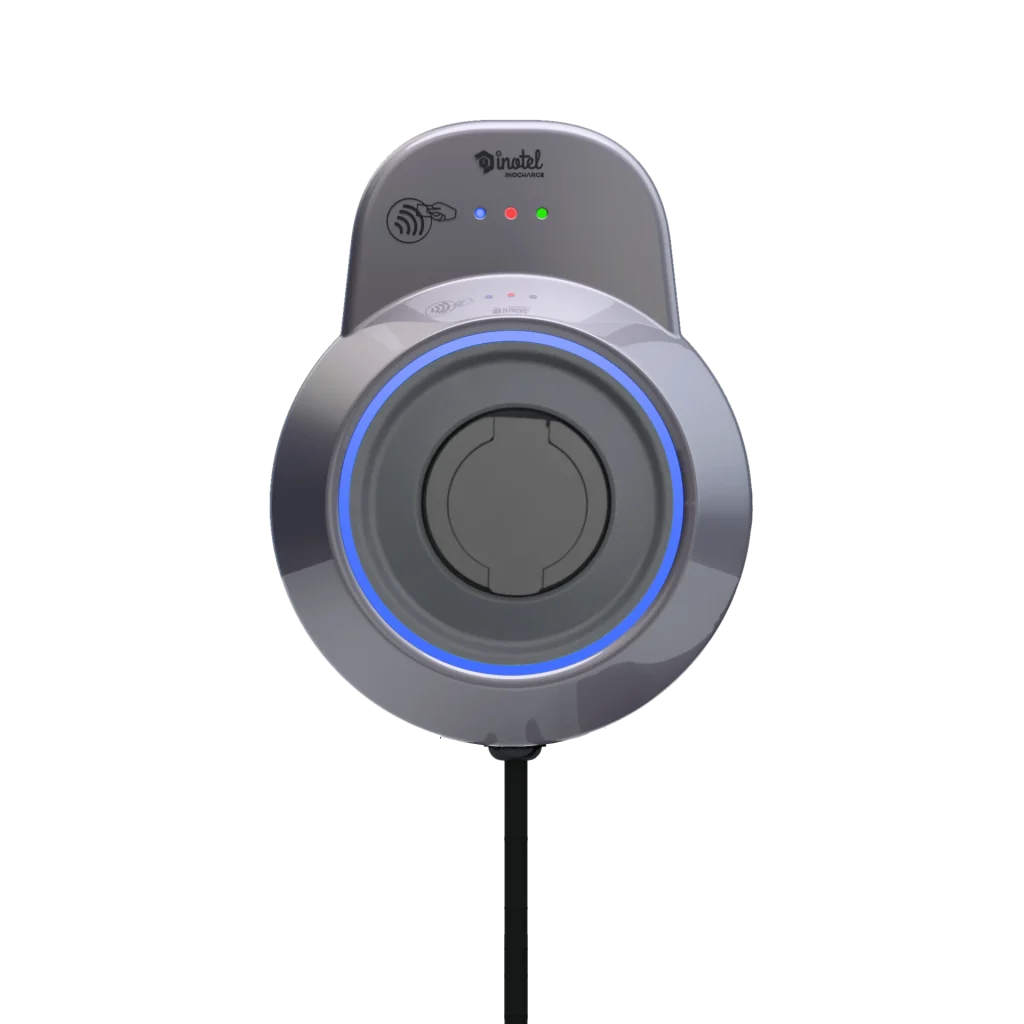
The current INOCHARGE cabled unit provides a 5 m attached vehicle cable with a Type 2 plug. The socketed unit provides a Type 2 outlet and needs a separate suitable cable. Check that a detachable cable has the required connector, current and phase characteristics; not every cable with the same connector supports the same power.
Also check whether the cable reaches the car in the way you normally park. Inlet position can change the usable route considerably. Do not force a connector or rely on an unverified adaptor to turn an unsuitable combination into a compatible one.
If the displayed power is lower than expected
Review the vehicle’s charge target, schedule and current limit, the wallbox setting and the cable specification. Establish whether you are comparing an instantaneous value or a session average. Check that the expectation came from an AC figure. Share those observations with the installer or vehicle support team without opening the charger or altering the electrical installation yourself.
AFDC’s charging-equipment overview explains the general charging paths. A manufacturer’s conditional charging table illustrates why model and operating conditions must be read together. Your final compatibility decision should use the documents for your actual car and the professionally assessed installation.
Use the verified power limit in the AC charging-time calculation, then consider cable reach and storage with the tethered versus socketed comparison.
Source links and technical information last checked: 17 November 2026.